Air Conditioning Repair, Installation and Maintenance
Service Denver
Plumbing | Heating | Cooling
Cooling
Choosing a cooling system and contractor is an important decision. Whether it’s for service, maintenance or installation of a new air conditioning system or an evaporative cooler it’s a decision you don’t take lightly. At Service Denver Plumbing, Heating & Cooling we want to provide you with the most information we can to help you make the right decisions. After all, the safety and comfort of your home and your family are in the hands of the company you choose. Today’s best air conditioners use 30% to 50% less energy to produce the same amount of cooling as air conditioners made in the mid 1970s. Even if your air conditioner is only 10 years old, you may save 20% to 40% of your cooling energy costs by replacing it with a newer, more efficient model.
Air Conditioning Frequently Asked Questions
In Colorado we are fortunate to have a choice between two types of cooling with air conditioning or evaporative cooling. Which is best is dependent upon your personal desires and needs. We want to help you make the right decision, so we have provided a wealth of information on each type of system. Please feel free to browse around. Just click on the links and you will be able to navigate between the two systems. And, of course, should you have any questions please give one of our Comfort Specialists a call.
Today’s best air conditioners use 30% to 50% less energy to produce the same amount of cooling as air conditioners made in the mid 1970s. Even if your air conditioner is only 10 years old, you may save 20% to 40% of your cooling energy costs by replacing it with a newer, more efficient model.
Air conditioners are rated by the number of British Thermal Units (Btu) of heat they can remove per hour. Another common rating term for air conditioning size is the “ton,” which is 12,000 Btu per hour. The size of an air conditioner depends on:
- how large your home is and how many windows it has;
- how much shade is on your home’s windows, walls, and roof;
- how much insulation is in your home’s ceiling and walls;
- how much air leaks into your home from the outside; and
- how much heat the occupants and appliances in your home generate.
An air conditioner’s efficiency, performance, durability, and initial cost depend on matching its size to the above factors.
Two groups – the Air Conditioning Contractors of America (ACCA) and the American Society of Heating, Refrigerating, and Air Conditioning Engineers (ASHRAE) – publish calculation procedures for sizing central air conditioners. Reputable air conditioning contractors such as Service Denver Plumbing, Heating & Cooling will use one of these procedures, often performed with the aid of a computer, to size your new central air conditioner.
Be aware that a large air conditioner will not provide the best cooling. Buying an oversized air conditioner penalizes you in the following ways:
- It costs more to buy a larger air conditioner than you need.
- The “larger-than-necessary” air conditioner cycles on and off more frequently reducing its efficiency. Frequent cycling makes indoor temperatures fluctuate more and results in a less comfortable environment. Frequent cycling also inhibits moisture removal. In humid climates, removing moisture is essential for acceptable comfort. In addition, this cycling wears out the compressor and electrical parts more rapidly.
- A larger air conditioner uses more electricity and creates added demands on electrical generation and delivery systems.
Each air conditioner has an energy-efficiency rating that lists how many Btu per hour are removed for each watt of power it draws. For room air conditioners, this efficiency rating is the Energy Efficiency Ratio, or EER. For central air conditioners, it is the Seasonal Energy Efficiency Ratio, or SEER. These ratings are posted on an Energy Guide Label, which must be conspicuously attached to all new air conditioners. Many air conditioner manufacturers are participants in the voluntary EnergyStar® labeling program (see Source List in this publication). EnergyStar®-labeled appliances mean that they have high EER and SEER ratings.
In general, new air conditioners with higher EERs or SEERs sport higher price tags. However, the higher initial cost of an energy-efficient model will be repaid to you several times during its life span. Your utility company may encourage the purchase of a more efficient air conditioner by rebating some or all of the price difference. Buy the most efficient air conditioner you can afford, especially if you use (or think you will use) an air conditioner frequently and/or if your electricity rates are high.
Room air conditioners generally range from 5,500 Btu per hour to 14,000 Btu per hour. National appliance standards require room air conditioners built after January 1, 1990, to have an EER of 8.0 or greater. Select a room air conditioner with an EER of at least 9.0 if you live in a mild climate. If you live in a hot climate, select one with an EER over 10.
The Association of Home Appliance Manufacturers reports that the average EER of room air conditioners rose 47% from 1972 to 1991. If you own a 1970s-vintage room air conditioner with an EER of 5 and you replace it with a new one with an EER of 10, you will cut your air conditioning energy costs in half.
National minimum standards for central air conditioners require a SEER of 9.7 and 10.0, for single-package and split-systems, respectively. But you do not need to settle for the minimum standard—there is a wide selection of units with SEERs reaching nearly 17.
Before 1979, the SEERs of central air conditioners ranged from 4.5 to 8.0. Replacing a 1970s-era central air conditioner with a SEER of 6 with a new unit having a SEER of 12 will cut your air conditioning costs in half.
The sound level of the out door section may be important to you do to the units location, or proximity to your neighbor’s window. Most units today have sound ratings that are measured in decibel ratings.
You should expect the unit to have an adjustable thermostat, at least two cooling speeds, two fan speeds and an energy efficient setting, which stops the fan when the unit is not cooling. The unit should have an adjustable vent, which allows you to aim the cool air, and an exhaust vent setting allowing fresh air to be introduced from outside. The filter should be easily accessible for removal and cleaning. You want a manufacturer’s warrantee for at least 5 years, with full replacement for at least 1 year.
Some of the newer units have an electrostatic filter available either standard or as an option. This filter will remove extremely small particles from the air. This is a super feature for people with allergies.
Guess what? Your electricity bill is probably unreadable, I know mine is. Theoretically, you should add the generation cost per kilowatt-hour to the delivery cost per kilowatt-hour to get a true cost. However, many areas charge different rates for different usage and have a surcharge for high usage during summer months.
An easy way is to divide the total payment by the kilowatt-hours used. Do it for your last bill and for last summer’s bill and use the higher of the two numbers. This number is not totally accurate, but it works well. (The number should be about 5-50 cents. If it isn’t you probably did the sum wrong.)
Don’t forget. The national grid is old and needs work. Nuclear power plants are aging too, and will cost a fortune to replace. Oil powered generation will be effected by high oil prices. You can bet money that conventionally generated power is not going to get cheaper.
Start with the EER of your old unit. Subtract 1 from this EER for every 5 years of its age — more if you never clean it. Use the guide to generate the annual cost for the old unit and for the unit you want to buy. You may have to extrapolate if the figures are beyond the range of your chart. Subtract the two numbers to get the annual savings. Divide the purchase price by the annual savings to get the payback time. If the payback time is lower than the warrantee period, it’s like money in the bank. If it is less than double the warrantee period, it is still probably a good buy.
In Denver, CO which has a cooling season of about 600 hours per year and your adjusted electricity cost is about 25 cents per kilowatt-hour. Replacing a 6000 BTU/Hour 6-EER unit with a 5800 BTU/Hour 11 EER unit will save about $60 a year. If you pay $300 for the new unit then you will get your money back in 5 years.
You should buy the unit of the correct capacity and type that has the highest EER, if you can afford it. Buying a unit of lower EER that costs less is usually a false economy.
Air Conditioning Repair
Repair Services
- Coil Repairs
- AC Freon Leak Repairs
- AC High Voltage Repairs
- Frozen Air Conditioner Repairs
- Contactor Repair
- Capacitor Repair
- Worn AC Wiring Repair
- Repair Damaged Control Voltage Wire
- Air Conditioner Condenser Fan Motor Repair
- AC Compressor Repair
- Condenser Freon Leak Repair
- Repair Accessible Freon Lines
- Replace Furnace Control Board
- Repair Indoor Evaporator Coil
- Indoor Mold Prevention Treatment
- Repair Drain Lines
- Repair Abnormal Air Conditioner Cooling Operating Temperatures
- Thermostat Repairs and Replacements
- Ductwork Leakage Repair
- and many other repairs!!
Doesn’t it all come down to trust?…
- Most major makes and models
- Available 24 hours per day
- Available 365 days per year
- Licensed, bonded and insured
- N.A.T.E. certified
- N.C.I. members
- Recipients of BBB Gold Star Award
- Over 25 years experience
- 76% of our business comes from referrals
Air Conditioning Maintenance
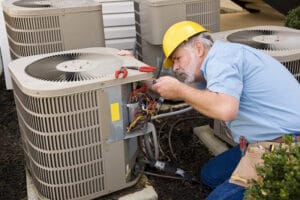 Air conditioning manufacturers make rugged, high quality products that are designed to withstand the elements i.e. snow, wind, rain, sun, and extreme heat/cold. However, an air conditioner’s filters, coils and fins require regular maintenance for the unit to operate effectively and efficiently throughout its years of service. Unlike the evaporator coil, the condenser coil is exposed to unfiltered outdoor air. Air borne dirt will become lodged in the condenser when the outdoor environment is dusty, or if there is foliage near by. Depending on where you live dirt can build up very quickly. Just about everything that contacts the coil surface can have an insulating effect. Dirt, dust, seeds, bugs, foliage, grease, corrosion, pollution, and even bacteria and other microorganisms can act as an insulating barrier. Anything that touches the coil reduces the heat transfer of unwanted heat from the refrigerant to the outside air.
Air conditioning manufacturers design equipment to achieve the highest SEER level of efficiency using the least amount of refrigerant. The systems are perfectly balanced and anything that affects the heat transfer creates an imbalance which drastically affects performance. A dirty coil reduces heat transfer which causes temperature and pressure of the refrigerant entering the compressor to increases above normal levels. The compressor will than work harder and draw more amps to keep up. The cooling capacity of the system will be greatly reduced and the mechanical components will be significantly stressed. A dirty coil means a higher operating cost, more wear and tear on the compressor and fans, and inadequate cooling.
Coils that have little maintenance performed often become clogged with seeds and dirt over time. If the condenser airflow is restricted on a hot day the compressor head and cylinders will become extremely “hot”. The oil will than begin to break down and lose its ability to lubricate causing accelerated wear and allowing contaminants to enter the system. This can cause rings, pistons and cylinders to wear resulting in lower compression, leaking valves, and metal debris in the oil. Once this occurs compressor failure will soon follow. Air conditioners are a closed loop system and changing the oil is not a normal or easy procedure. The oil used in air conditioning systems is extremely resilient but will prematurely break down if the system is not looked after. Imagine trying to drive your car for 10 years without ever changing the oil. When a hermetic compressor fails the only way to fix the system is to replace the compressor. This involves opening the system, having the refrigerant and oil removed, and filter dryers installed to clean up the system of moisture and acid that will be introduced from opening the system and left from the failure. This is a very costly procedure and many systems at this point are not worth fixing.
The benefits of keeping the coil clean are:
- Equipment operates at a lower temperature and removes more heat.
- You have lower operating amperage, resulting in lower energy costs
- Compressor is operating at maximum efficiency and will operate less
- Equipment will last longer and be more reliable
Regular maintenance should be performed by a professionals. Check out the benefits of our Value Maintenance Agreement